
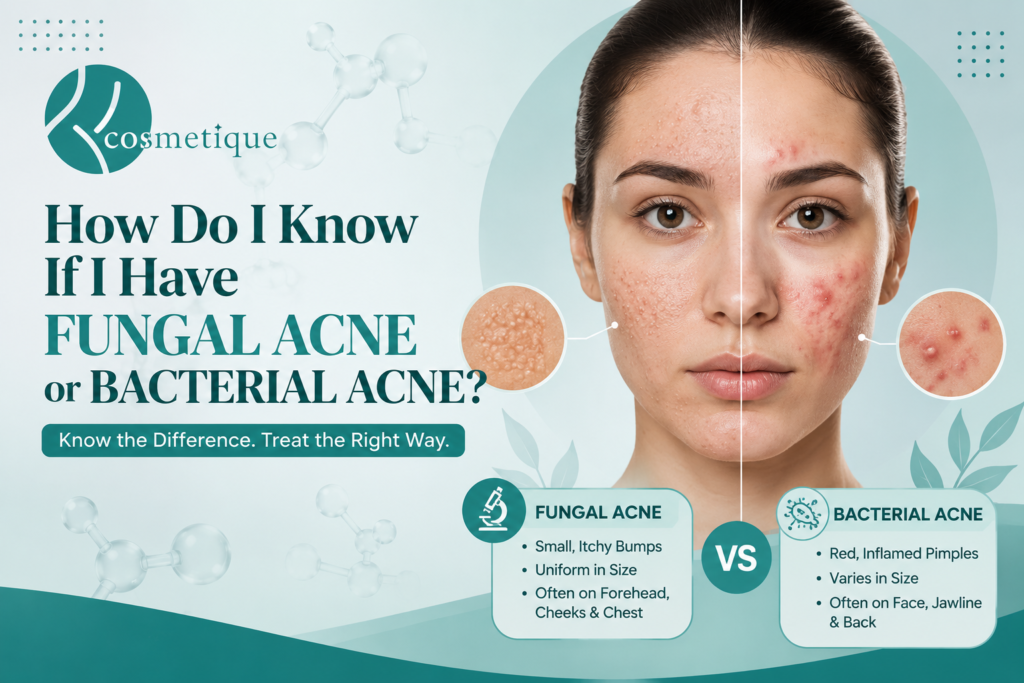
Let’s Be Real for a Second
You wake up, look in the mirror, and see those tiny red bumps on your forehead, chest, or back. You immediately reach for your trusty salicylic acid cleanser or benzoyl peroxide spot treatment. A week passes, and nothing changes. In fact, the bumps look angrier, itchier, and there are more of them.
If this sounds familiar, you might not have bacterial acne at all. You might have fungal acne — and the treatments for bacterial acne can actually make your skin worse. Getting the right diagnosis is crucial, which is why consulting a qualified skin specialist in Lahore can save you months of frustration and ineffective treatment.
Here’s how to finally figure out which one you have.
Fungal Acne vs Bacterial Acne: The Quick Comparison
| Feature | Fungal Acne | Bacterial Acne |
|---|---|---|
| Cause | Malassezia yeast overgrowth on the skin | Cutibacterium acnes bacteria trapped with sebum |
| Appearance | Uniform, tiny red bumps and pus-filled bumps—all roughly the same size | Mixed sizes—blackheads, whiteheads, cysts, nodules |
| Itchiness | Extremely itchy or persistently mild itching | Rarely itchy (can be painful instead) |
| Location | Chest, back, shoulders, forehead, hairline—sweat-prone areas | Face (especially T-zone and jawline), neck, back |
| Reaction to standard acne treatments | No improvement or gets worse | Improves with benzoyl peroxide, salicylic acid |
| Flare triggers | Sweat, humidity, antibiotics, tight clothing | Hormones, pore-clogging products, stress |
7 Ways to Tell Them Apart
1. Look at the Size and Shape
Fungal acne looks like a field of tiny, uniform red bumps. They are all roughly the same size—small papules or pustules that don’t grow into large, painful lumps. They often cluster together in patches and may feel rough to the touch.
Bacterial acne is a mixed bag. You’ll see blackheads, whiteheads, and larger, deeper, painful cysts and nodules. They vary in size and are scattered rather than clustered uniformly.
2. Check the Itch Factor
This is the biggest giveaway that dermatologists look for.
Fungal acne is intensely or persistently itchy. The Malassezia yeast produces byproducts that trigger inflammation and histamine release in your skin. If you find yourself constantly scratching your chest, back, or forehead bumps, suspect fungal acne.
Bacterial acne rarely itches. It can be painful, tender, or throbbing, but not itchy. If your bumps don’t itch, they are likely bacterial. A good skin specialist in Lahore will always ask about itching first—it’s one of the quickest ways to tell the two apart.
3. Location, Location, Location
Fungal acne loves sweat-prone areas:
- Chest and upper back
- Forehead and hairline (especially if you wear bangs or hats)
- Shoulders
- The scalp (often accompanied by flaking not unlike dandruff)
Bacterial acne is more versatile:
- T-zone (nose, chin, forehead)
- Jawline and cheeks (especially hormonal acne)
- Neck
- Back (though back acne can also be fungal, so cross-check with other clues)
4. The Product Test
This is a DIY test you can do at home.
- Apply a benzoyl peroxide or salicylic acid product to one small patch of bumps for 3–4 days.
- If the bumps flatten and shrink → likely bacterial acne.
- If the bumps get redder, more numerous, or itchier → likely fungal acne.
Why? Benzoyl peroxide and salicylic acid are antibacterial but do nothing against yeast. They can also disrupt your skin barrier, creating an environment where yeast thrives even more. In fact, using antibacterial treatments on fungal acne can make the overgrowth worse by killing off the bacteria that normally compete with Malassezia.
5. Check Your History
Ask yourself these questions:
- Have you recently taken oral antibiotics? Antibiotics wipe out good bacteria on your skin, allowing yeast to overgrow. Fungal acne is notorious after a course of doxycycline or other antibiotics.
- Do you sweat a lot? Gym-goers, athletes, and people in humid climates are prone to fungal acne. In Pakistan’s climate, where temperatures frequently exceed 35°C and humidity can reach 80%, fungal acne has become increasingly prevalent.
- Do you wear tight synthetic fabrics? Nylon and polyester trap sweat and heat, creating a yeast-friendly environment.
- Did your acne start suddenly? Fungal acne often flares up aggressively within 24–48 hours of a trigger.
6. Are Your Skincare Products Feeding the Yeast?
This is a lesser-known but crucial clue.
Malassezia yeast feeds on certain oils and esters—specifically fatty acids like coconut oil, olive oil, and certain esters that appear frequently in conventional skincare. If you’re using moisturizers, sunscreens, or serums with these ingredients and your acne is worsening, it’s likely fungal.
Bacterial acne, on the other hand, is worsened by heavy, pore-clogging ingredients like mineral oil, lanolin, or cocoa butter.
7. What Does the Pus Look Like?
If you have pustules, examine the contents:
- Fungal acne pus is typically white, thick, and sometimes stringy.
- Bacterial acne pus is yellow, creamy, and comes from larger, deeper pores.
(And please—don’t pop them! Popping fungal acne can spread the yeast to surrounding follicles.)
When to See a Skin Specialist in Lahore
If you’ve tried home remedies for 2–4 weeks and see no improvement—or if your skin is worsening—see a skin specialist in Lahore. A dermatologist can:
- Perform a skin scraping or KOH test to confirm fungal overgrowth under a microscope
- Perform a culture to identify the exact bacteria or yeast strain
- Prescribe stronger treatments like oral fluconazole (for fungal) or appropriate antibacterials (if bacterial)
Lahore has several qualified dermatologists who can help:
| Skin Specialist | Qualifications & Experience | Contact/Clinic |
|---|---|---|
| Prof. Dr. Azim Jahangir Khan | American Board Certified Dermatologist; over 35 years of US experience; Founder of Cosmetique | Cosmetique, Lahore; 03-111-077-111 |
| Dr. Syed Atif Hasnain Kazmi | MBBS, M.C.P.S (Dermatology), M.D (Dermatology); 35+ years experience | Prof. Atif Hussain’s Clinic, New Garden Town; Fee: PKR 4,000 |
| Dr. Ghazala Butt | MBBS, M.D (Dermatology), Ph.D; 18+ years experience | Clinic, Lahore |
| Dr. Aisha Ghias | MBBS (KEMU), FCPS; Associate Professor at Mayo Hospital; 10+ years experience | Super Skin Centre, Bajwa Hospital, Shahdara |
If you’re looking for a trusted skin specialist in Lahore, Cosmetique has a team of board-certified dermatologists with US and UK qualifications who can accurately diagnose and treat both fungal and bacterial acne.
What to Do Next
If You Suspect Fungal Acne:
- Switch to a fungal-acne-safe routine. Check your product ingredients for oils that feed Malassezia.
- Wash with a dandruff shampoo containing ketoconazole (Nizoral) or selenium sulfide. Apply as a 5-minute mask on affected areas, 2–3 times a week.
- Change out of sweaty clothes immediately after workouts.
- Wear loose, breathable cotton fabrics.
If You Suspect Bacterial Acne:
- Use benzoyl peroxide (spot treatment or wash) to kill bacteria.
- Introduce salicylic acid or a retinoid (adapalene) to unclog pores.
- Do not over-exfoliate—damaging the barrier worsens bacterial acne.
Final Summary
| Clue | Fungal Acne | Bacterial Acne |
|---|---|---|
| Itches? | YES | NO |
| Uniform bumps? | YES | NO (mixed sizes) |
| Flares after antibiotics? | YES | NO |
| Improves with benzoyl peroxide? | NO | YES |
| Flares in heat/sweat? | YES | Sometimes |
| Location | Chest, back, hairline, forehead | Face, jawline, neck |
The Takeaway
Misdiagnosing your acne wastes your time, money, and patience. More importantly, treating fungal acne with antibacterial products can actively make it worse.
Take a close look at your bumps. Ask yourself the questions above. And remember: itchy, uniform, sweat-related bumps = likely fungal. Painful, mixed, blackhead-prone bumps = likely bacterial.
Once you know what you’re dealing with, you can finally choose the right treatment and get the clear skin you deserve. If you’re unsure, don’t hesitate to book an appointment with a qualified skin specialist in Lahore for an accurate diagnosis and personalized treatment plan.


